Henfaes Isaf is a house with a long history. It is a rare survival of a mediaeval peasant hall-house dating from the 1500s. It would have been occupied by a farming family of some local standing, plus their livestock. The family would have lived in the original house area (now the kitchen and living room) whereas the cows would have sheltered in what is now the utility area. At that time it would have been a long, low building, probably timber-framed – you can see some sixteenth century timbers in the bathroom and small bedroom, showing the original roof line of the house.
What would it have been like in 1550? Relaxing on the sofa in the living room one can imagine sitting on a wooden bench, pegged into the panelled wall behind. An open-hearth fire in the centre of the room would have provided some welcome warmth to the room which was open to the rafters. With smoke drifting up through a hole in the roof, it must have been very dark and smoky, although probably quite cosy in the winter.
The present fireplace with its substantial beam was built in the seventeenth century. The beamed ceiling was also added at this time, creating a loft sleeping place above – you can still see the location of a trapdoor for the ladder in the corner of the room. The walls would have been rebuilt in stone at this point. Later on, the farm must have been thriving as the haybarn and stable extension was added (now the dining room and playroom area) plus some outbuildings (see the datestone engraved “T E 1770” in the wall of the corner seating area, which is the only remnant of the henhouse, wash-house and pigsty). You can also see initials carved into the beams in the playroom – this would have been where the farm workers slept. Then in Victorian times the roof line of the house was raised to provide bedrooms, as we see today.
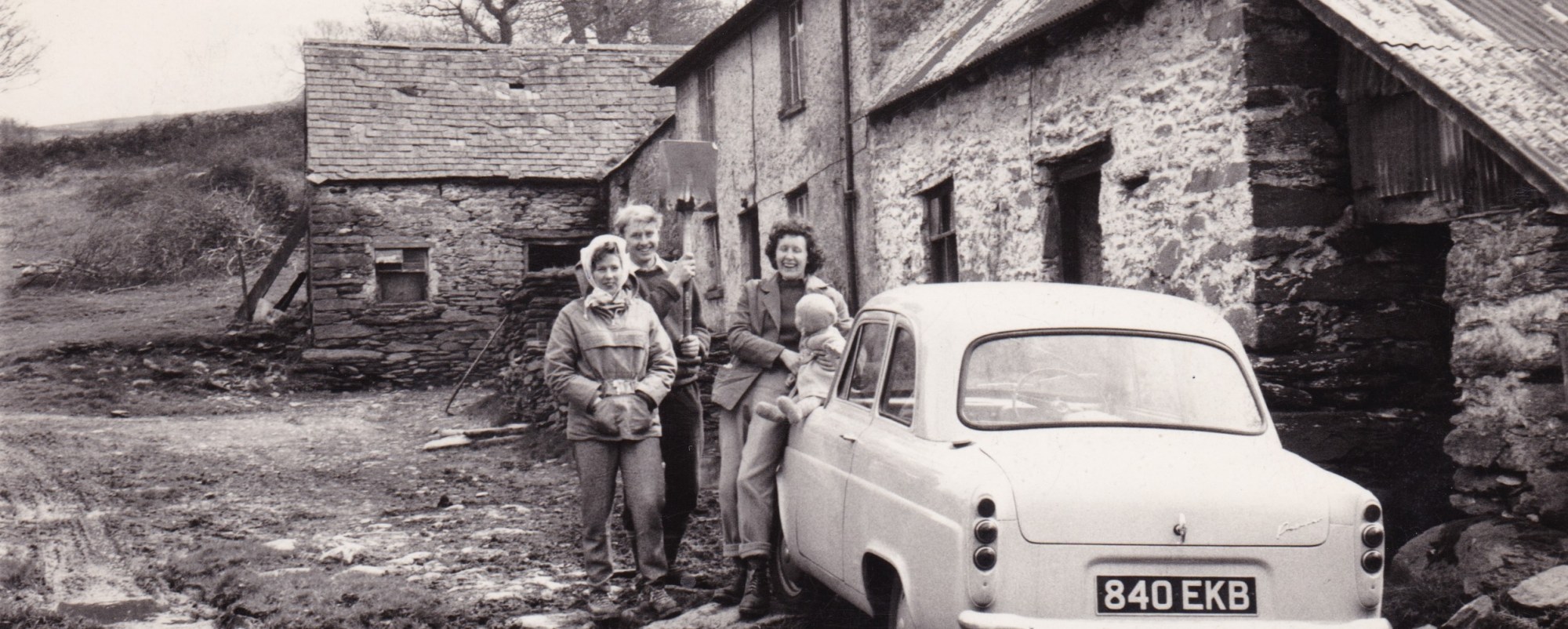
In 1961 Henfaes Isaf was sold to Moyra’s aunt and uncle, Bet and Stan Booth. As you can see from the photo above, it was very dilapidated, had no running water and minimal electricity. After some renovations, the cottage became a holiday bolthole, and the Booths liked the area so much they took over the village pub, the Blue Lion.
In 1973 Bet’s brother Ken James bought the property with his wife Hilda. Ken was a man of great practical skill and considerable vision and over the next 15 years the property was comprehensively renovated. The work was done at weekends and over school holidays until Ken and Hilda retired there in 1987. It was a family project, with all work completed entirely by Ken and Hilda, with their daughters Fiona and Moyra. During the renovations, Ken and Hilda discovered and preserved many original features such as the oak post-and-panel wall which was hidden behind layers of wallpaper. Similarly, the cruck timbers had been covered over by panelling. Stripping back the fireplace revealed the original hearth and the bread oven. Ken was a great believer in what we now call recycling and upcycling, and a lot of the “new” timbers at Henfaes Isaf were sourced from demolition sites in Liverpool, so the house now includes beams from a church and a synagogue!
Ken died in 2009 and Hilda carried on living at Henfaes until 2015, with support from friends and neighbours until it eventually became too much and she moved to be nearer Fiona on the North Wales coast. Moyra with her partner Ian and her cousin Janna bought Henfaes Isaf and now run it as a holiday home. So Henfaes Isaf is still in the family 60 years later, and this generation are very proud to be a part of the history of this special place.
We would love you to be a part of this special story.

“Stunning furniture and clearly lots of love went into restoring the building. Highly recommended”
Duncan, April 2024
 Henfaes Isaf Holiday Cottage